

EPOS & Till Systems
EPOS & Till Systems for Catering, Hospitality & Unattended retail
VMC (UK) Ltd builds EPOS systems and till systems for catering operators who cannot afford slow queues. We have designed, manufactured and supported EPOS till systems in Britain since 1991. Our engineers have installed more than 2,500 tills across over 1,000 sites. One of our systems serves 700,000 employees and processes more than 1.5 million transactions every day across 5,000 machines and terminals.
We write our own software. We install it ourselves and we support it ourselves. No reseller sits between you and the people who made your till system work.
What an EPOS System Actually Does
EPOS stands for electronic point of sale. Americans say POS system. British caterers say EPOS system, till system or simply tills. The words describe the same thing: the screen your staff touch, the software behind it, and the reporting that tells you what sold. Search behaviour splits the same way. If you have landed here after typing uk pos, pos system UK, or EPOS systems UK, you are looking at the same product.
A cash register records money. An EPOS till records everything else, too. It records the dish, the portion, the time, the operator, the payment method, the allergen flag and the cost centre. That difference matters at the end of the month, when you need gross profit by site rather than a Z-read from a drawer.
Older tills stored data on the terminal. Cloud tills store it on a server. Neither model suits every catering site on its own. A staff restaurant in a basement with poor signal needs local processing. A group of forty cafés needs central menu control. We build hybrid systems that process locally and sync centrally, so the till keeps trading when the broadband drops and head office still sees the numbers.
Fixed PoS

- Easy to operate
- Customisable marketing screen
- Meal deals, promotions & loyalty
- Multiple payment readers
Mobile PoS

- Fully portable till
- Small and light weight
- Integrated smartcard reader
- Connects via Wi-Fi
Self-Service PoS
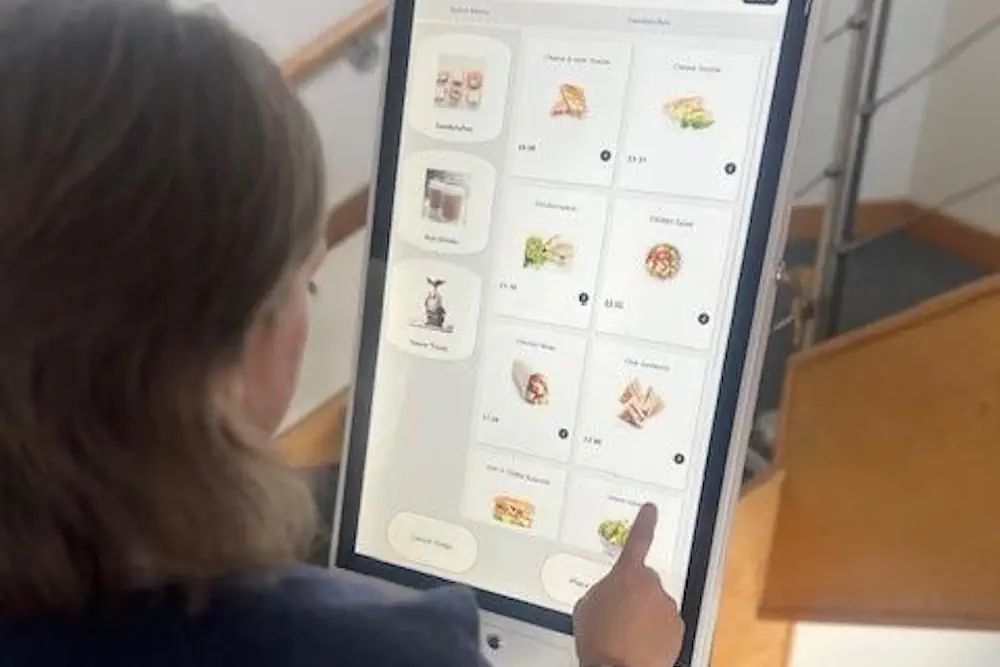
- Full EPOS till or just card readers
- Reduce staffing costs
- Maintain a speedy service
- Ideal for 24/7 environments
POS that’s designed to perform
- Latest technology with interactive touchscreens
- Contactless, chip & pin, mobile and cashless payments
- Cloud based management software
- User-friendly management portal
- Integration with existing systems & software if needed
- A scalable solution that can grow with you
Unversity of Brighton
Why UK Operators Replace Their Tills Now
Cash has almost gone. UK Finance recorded 18.9 billion contactless transactions in 2024, with an average value of £15.86. Barclays reported that 94.6% of eligible in-store card payments went through contactless that year. A canteen that still counts coins wastes staff hours on a payment method most people no longer carry.
Costs have moved sharply. The National Living Wage rose 6.7% to £12.21 an hour in April 2025 and rises again to £12.71 in April 2026. Employer National Insurance went up to 15% and the secondary threshold dropped from £9,100 to £5,000. UKHospitality puts the wage increase alone at roughly £1.4 billion across the sector.
Volume has not risen to match. Britain had 45,000 pubs in 2024, down from 60,800 in 2000. Around 176,685 businesses trade in accommodation and food services. Most of them run on thin margins and a short lunch peak.
So the case for a better EPOS system is not about fashion. It is about serving more covers per hour with the same team, cutting waste, controlling portion cost and taking payment in two seconds instead of twenty.
Hospitality EPOS Systems
A hospitality EPOS system has to survive service. Wet hands. Shouting. Three tables at once. Our restaurant EPOS screens use large, clear buttons and short menu paths, so a new starter can take an order on their first shift without a manual.
EPOS for restaurants needs table plans, split bills, course timing, item modifiers, voids with reason codes and open tabs. It needs to hold a bar tab while the same operator serves a takeaway. It needs to print the starter to the cold section and the main to the grill.
Our restaurant EPOS system handles all of that, plus the parts operators forget until week three: staff discount rules, manager overrides, service charge splits, price bands by time of day, and happy hour pricing that switches itself off.
Mobile POS and Ordering at the Table
Mobile POS systems move the till to the guest. Your team takes the order at the table and fires it to the kitchen before they walk away. Nobody queues at a terminal. Nobody misreads a scribbled pad.
Handhelds also take payment where the guest sits. Pay at table. It shortens every meal by five minutes. Across a hundred covers, that is another sitting.
Mobile pos works well outdoors too. Festivals, terraces, pop-up serveries, stadium concourses and street food units all run better on handhelds than on fixed tills. Our handhelds hold transactions locally if the signal drops and upload them when it returns.
Kitchen Display Systems
A kitchen display screen replaces the printer and the paper ticket. Orders arrive on screen, sorted by section and by time. Chefs bump items as they leave the pass. The system tracks how long every ticket took.
That last point changes management conversations. You stop arguing about whether Friday was slow. You look at ticket times by hour and see exactly where the pass fell behind.
KDS also cuts errors. Fewer lost dockets means fewer remakes, fewer comped dishes and less food in the bin. Screens survive heat and steam better than thermal printers, and they never run out of paper mid-service.
Self Service Kiosks
Self-service kiosks do two jobs. They cut queues and they raise spend per head. Guests browse without feeling rushed, read the whole menu, and add the side they would have skipped at a counter. McDonald’s UK reported a 30% rise in average order value after its kiosk rollout.
Kiosks also change your labour model. Two people can run a servery that needed four, and the two you keep work on food rather than money.
We build kiosks for staff restaurants, university cafés, hospital retail units, transport hubs and grab-and-go counters. Every kiosk we install accepts contactless, chip and PIN, Apple Pay, Google Pay and the VMC Flex cashless account. Each one shows allergen information at the point of choice, and each one meets accessibility requirements for reach, contrast and screen height.
Micro Markets and Unattended Retail
Hybrid working broke the traditional canteen. Occupancy swings from 30% on Monday to 90% on Wednesday, and a full servery cannot flex that fast.
A micro market solves it. Open shelving, chilled cabinets, a self-checkout kiosk and no staff. Employees shop at any hour, tap their Flex account or a card, and walk out. You keep a food offer on quiet days without paying for a full brigade.
We can install contactless vending readers and EPOS alongside micro markets, so one account covers the market, the machines and the manned counter.
EPOS for Contract Catering
- Contract catering breaks most standard tills. A caterer running fifty client sites needs one system that reports by client, by unit, by cost centre and by consolidated group, all at once. Off-the-shelf hospitality software rarely goes that deep. We have built for contract caterers since the 1990s. Our systems handle the parts that matter on a client contract and on a tender response.
- Subsidy management. Employers subsidise meals in dozens of ways. Flat discount. Percentage discount. Daily allowance. Meal deal cap. Free breakfast before 9 am. Different rules for agency staff, visitors and directors. Our software applies the correct rule at the till without the operator choosing anything.
- Cost centre billing. Hospitality orders, meeting room catering and departmental charges post to the right budget code automatically. Finance gets a clean split at month-end.
- Salary deduction and account billing. Employees spend against a payroll account. We export the deduction file to payroll on your schedule. Charge to room works the same way for hotels and residential sites.
- Client reporting. Every client wants their own numbers. Sales by day part. Take-up rate. Average transaction value. Product mix. Subsidy spend against budget. We produce these by site and by group, on a schedule, without anyone rekeying a spreadsheet.
- Rapid mobilisation. Contract catering moves fast when a bid lands. We hold stock, build menus centrally and deploy tills to a new site quickly, using the same configuration you already run elsewhere.
Cashless Catering Systems for Schools, Colleges and Universities
Cashless catering systems for schools solve three problems at once. They speed up a twenty-minute lunch queue. They stop cash moving around a building. They hide who receives a free meal.
Our school and campus systems identify pupils by card. Parents top up online. Balances update in seconds. Staff see allergen and dietary alerts on screen the moment a pupil registers at the till.
We have run university cashless catering for years. Nottingham Trent University has worked with us since 2007 and we replaced the EPOS estate across the City and Clifton campuses. The University of Brighton has used VMC Flex since 2010, serving roughly 83,000 students a month.
Till System Hardware
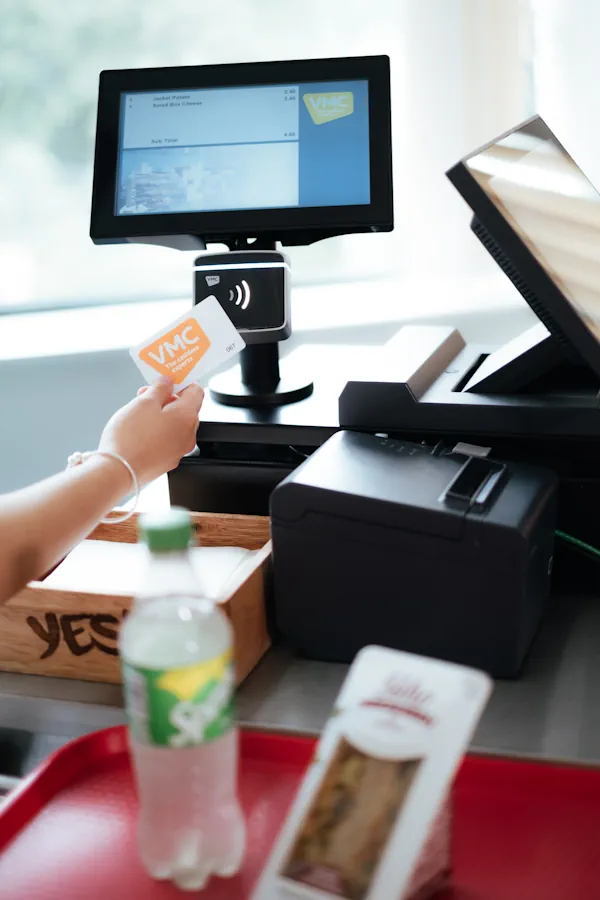
- Fixed terminals. All-in-one touchscreens built for spillage, heat and constant use.
- Handheld tills. Rugged devices for table service, terrace service, roaming sales and stock counts.
- Self-service kiosks. Freestanding, wall-mounted or countertop, with integrated card readers and receipt printers.
- Kitchen display screens. Heat-tolerant monitors with bump bars or touch control, routed by section.
- Receipt and kitchen printers. Thermal printing, auto-cut, with printer redundancy so one failure does not stop the pass.
- Scales. Integrated weighing for deli counters, salad bars and pay-by-weight serveries.
- Card readers. Integrated terminals that take the amount straight from the till. No keying. No mismatched totals at cash-up.
- Cashless readers. Contactless readers for vending machines, coffee machines and unattended units, all linked to the same account as the manned tills.
- Customer screens. Second screens that show the order, the price and your promotions while the queue moves.
Talk to Us About Your Tills
Tell us how many sites you run, how many terminals you need and what your current system fails to do. We will specify a system for you, quote it properly and show you the software working before you commit.
Payments and UK Compliance
Integrated card payments.
The till sends the amount to the terminal. The operator taps nothing. Errors disappear and cash-up gets shorter. We support contactless, chip and PIN, Apple Pay and Google Pay.Closed loop and open loop together.
VMC Flex runs a closed-loop wallet with auto top-up, meal deals, loyalty and subsidy. VPay lets users pay by phone. Guests without an account still tap a bank card at the same terminal.PCI DSS.
Version 4.0.1 future-dated requirements became mandatory on 31 March 2025 with no grace period. We build to it.Allergens.
Natasha’s Law has applied since 1 October 2021 to food prepacked for direct sale. In March 2025, the FSA published best practice guidance stating that written allergen information should always sit alongside a conversation between staff and customers for non-prepacked food. That guidance is not law, but environmental health officers now use it as a benchmark, and a sign telling customers to ask a member of staff no longer stands up on its own. We hold allergen data against every recipe and display it at the till, on the kiosk and on the online menu.Calorie labelling.
The Calorie Labelling (Out of Home Sector) (England) Regulations 2021 came into force on 6 April 2022 for businesses with 250 or more employees. Contract caterers fall within the scope. Calories must appear at the point of choice with the statement that adults need around 2,000 kcal a day. Our menu build carries calorie data through to kiosk screens, digital menu boards and printed menus from one source.Data protection.
We process card, account and pupil data under UK GDPR. We hold the minimum, encrypt it and give you the documentation your DPO will ask for.Making Tax Digital and VAT.
Our reporting splits VAT by rate and by transaction, and exports to your accounting package in a format HMRC accepts.
Sectors We Work In
- Business and industry. Staff restaurants, coffee bars, micro markets and vending across corporate estates, including a system serving 700,000 employees.
- Education. Schools, sixth forms, colleges and universities, covering cashless catering, pre-order, parent payments and campus accounts.
- Contract catering. Multi-site deployment, subsidy management, client reporting and rapid mobilisation.
- Retail and grocery. We have supported one major grocer since 2007 across 911 stores and 25 fulfilment centres, serving over 200,000 colleagues, with installations in more than 1,500 Asda and Tesco stores.
- Healthcare. Staff restaurants and retail units with subsidy and account billing.
EPOS Till Systems | Built and Supported in the UK Since 1991
Till Systems That Keep Your Queue Moving
We design, build and install EPOS systems for hospitality, contract catering and education. Fixed tills, mobile POS, self service kiosks and cashless catering, all running on software we wrote ourselves.

Installation, Training and Support
Our engineers install every system. We survey the site, run the cabling if you need it, build the menu, mount the hardware and stay on site for the first service.
Training runs in short sessions on the actual tills, with your menu loaded. Most operators learn the basics in under an hour. Managers get a longer session on reporting and back office.
Support comes from our own team in the UK. Remote support fixes most issues in minutes. When a fault needs hands, we send an engineer. We agree response times before you sign, not after something fails during a lunch peak.
Data migration comes as standard. We take your existing product file, price bands and account balances and load them before go-live, so you do not start again from a blank screen.
Frequently Asked Questions
What is the difference between a POS system and an EPOS system?
None in practice. POS means point of sale and EPOS means electronic point of sale. British hospitality buyers say EPOS or till system. American and retail buyers say POS system.
Will the till work without internet?
Yes. Our terminals process locally and sync when the connection returns. Service continues through a broadband failure.
Can I keep my current card machine?
Sometimes. Standalone terminals still work, but you lose integration and keep the keying errors. Integrated card payments cut mistakes and shorten cash-up. We will tell you honestly whether your existing hardware integrates.
How long does installation take?
A single site usually goes live within a few weeks of the menu build. Multi-site rollouts run to an agreed programme. Most of the time goes on data, not on screwing brackets to walls.
Is this suitable for a small café?
Yes, though our strongest work sits in catering operations with subsidy, accounts, multiple sites or cashless requirements. If you run one café and want a basic till, let us know and we will advise accordingly.
Do EPOS systems handle allergens?
Ours does. We hold allergen and ingredient data per recipe and display it at the till, on kiosks and online. Staff see alerts against a registered pupil or account holder before they serve.
What is a kitchen display system?
A screen in the kitchen that replaces printed dockets. It sorts orders by section, times every ticket and lets chefs bump items as they leave the pass.
Do self service kiosks really increase spend?
They usually do. Guests read the full menu without queue pressure and add items they would otherwise skip. McDonald’s UK reported a 30% rise in average order value after its kiosk programme.
How does subsidy work at the till?
The system identifies the account holder, applies the rule set against them and prices the transaction automatically. Operators do not choose the discount, so nobody applies the wrong one.
Can EPOS integrate with our accounting software?
Yes. We have a number of different integrations available and also open to discussing current systems you use and how we can work with them.
Can one system cover vending, micro markets and manned tills?
Yes. That is what VMC Flex does. One account, one balance, one set of reports across machines, markets and counters.
What support do you provide after go-live?
UK-based remote support, on-site engineer attendance, agreed response times, software updates, and menu or price changes handled centrally if you want us to run them.
Trusted by
